
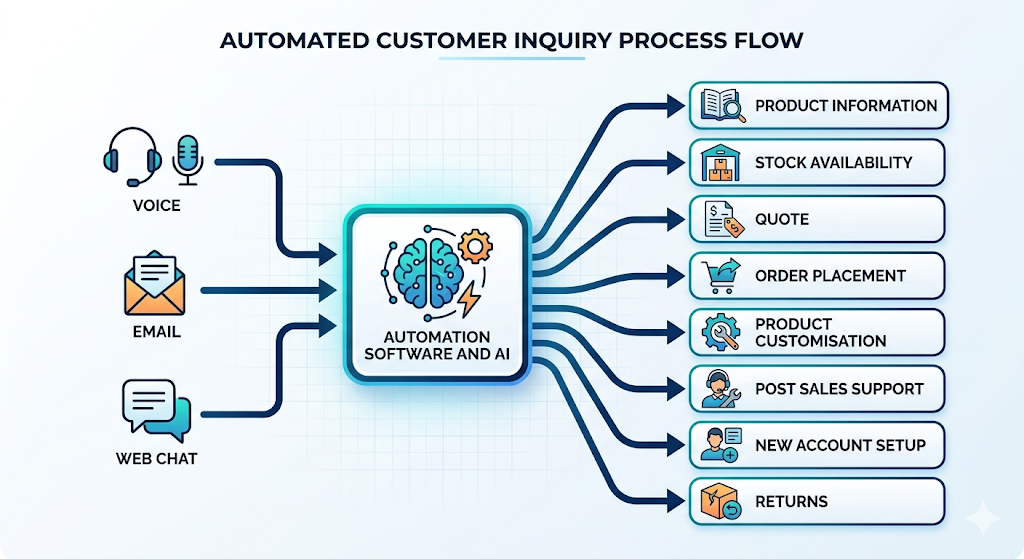
The cornerstone of success lies in the design, development, and documentation of a comprehensive sales and customer service process. This involves mapping out the ideal journey for leads and customers, ensuring every touchpoint is optimised for efficiency, consistency, and a superior experience.
Once the customer journey is clearly defined, we can implement the right tools and technologies, including software, automation, integrations, and AI. This approach ensures that every aspect of the sales and customer service process is standardised, scalable, and future-proof, creating a foundation for sustainable growth and operational excellence.
Mini-Project Process
To ensure the success of this initiative, the entire process is broken down into manageable “mini-projects”, each consisting of multiple bots working together to achieve specific objectives.
The following standardised process is applied throughout:
1. Define Scope
Clearly defining the scope is critical to setting the rules and objectives for each mini-project. This ensures alignment on what we are trying to achieve and establishes measurable outcomes.
Example: New Account Creation
Objective: Qualify leads, onboard legitimate trade customers, and get them purchasing as quickly as possible.
Key Steps:
- Qualify the lead to ensure they are in the target audience.
- Collect business and personal details.
- Perform checks to verify the customer is a legitimate trade account.
- Load the customer into the system and initiate their first purchase.
2. Develop, Review, and Refine Processes
This phase focuses on designing best-in-class customer experiences and efficient internal processes. It involves analysing and defining every step of the process, identifying roles, and determining what can be automated immediately versus what requires further development (e.g. Integrations).
Two Key Focus Areas:
- Customer Experience: Build a seamless, frictionless journey for the customer from start to finish.
- Internal Efficiency: Create the most effective and efficient processes and systems to support the customer journey.
Example – New Account Creation Process (High-Level):
- Qualify the customer as a trade customer versus retail.
- Capture business details and pre-fill forms automatically.
- Generate the first quote, payment, and sale during account setup (start generating revenue immediately).
- Automatically email the completed form for e-signature to speed up the process.
- Automate internal checks, such as: ABN search and website analysis.
- Automatically create a new account in the ERP system.
- Send out a welcome pack automatically.
- Initiate an automated follow-up and nurture process to encourage the first purchase.
This phase essentially builds the clear operating system for the AI Sales Agents to follow.
3. Build Knowledge Base
A comprehensive, accurate, and timely knowledge base is pivotal to the success of AI Sales Agents. Think of this as the training material for the agents, bad information leads to bad results.
Key Actions:
- Compile all the information the agents need to perform their tasks effectively.
- Ensure the knowledge base is regularly updated to maintain accuracy and relevance.
4. Build AI Sales Agents
Once the processes and knowledge base are in place, the next step is to build the AI Sales Agents. Each step in the process may involve multiple agents working together to complete tasks.
Example – New Account Creation Agents:
- Qualification Agent: Performs initial lead qualification.
- Business and Contact Capture Agent: Collects and organises customer details.
- Form Generation Agent: Pre-populates forms with captured data.
- E-Signature Agent: Facilitates online signatures for faster processing.
- Follow-Up Agent: Ensures timely follow-up with leads.
- Document Checking Agent: Verifies the accuracy of submitted documents.
- Research Agent: Conducts ABN and website checks.
- Account Setup Agent: Integrates with ERP/CRM systems to create new accounts.
- Lead Follow-Up Agent: Chases leads to ensure conversion.
- New Customer Nurture Agent: Initiates sales and builds customer relationships.
- Integration Agents: Push the customer through the process, including quoting, onboarding, and nurturing.
5. Test AI Sales Agents
Before going live, the AI Sales Agents are rigorously tested to ensure they perform as expected. This phase involves:
- Running the AI Sales Agents through various scenarios to identify gaps and areas for improvement.
- Training the AI Sales Agents to refine their performance and accuracy.
6. Live Testing and Oversight
Once the AI Sales Agents are performing at a high level, live testing begins under human supervision. This ensures:
- The agents deliver consistent, high-quality results in real-world scenarios.
- Any issues are identified and resolved before full deployment.
7. Ongoing Review, Testing, and Improvement
AI systems are never “set and forget.” Continuous monitoring, testing, and refinement are essential to:
- Adapt to new data and insights.
- Improve performance and efficiency over time.
- Ensure the system evolves alongside business needs and customer expectations.
Build Your Automated Sales & Customer Service Process
Building an AI Sales Agent is not a one-off project, but an ongoing, systematic approach to business growth. By allowing AI to handle the repetitive, high-volume work, your human team is freed to focus on high-value relationships and closing deals. This integrated system allows your business to increase revenue, protect margins, and drive operational efficiency.
Book an AI Sales Agent Strategy Session with Due North today to see how these automated systems can streamline your sales & customer service processes and give time back to your human reps.