What “Competitive Advantage” Means in Sales
Most business owners use the phrase “competitive advantage” like it’s a mission statement. Vague. Unmeasurable. Meaningless.
Let me give you the real definition — the one that actually matters in sales.
Competitive advantage means you can sell more, faster, at better margins, and at a lower cost than the business sitting next to you in the market. That’s it. It’s not a brand promise. It’s a measurable operational reality.
Michael Porter identified two ways to build genuine competitive advantage: cost advantage and differentiation advantage.
- Cost advantage means you do the same thing cheaper than the competition.
- Differentiation advantage means you do it better in ways customers actually value enough to pay for.
Most businesses are forced to choose one. The businesses that can deliver both simultaneously are extraordinarily hard to compete against.
An AI sales agent delivers both at the same time.
It cuts your cost of sale — fewer reps doing the administrative work that consumes the majority of every salesperson’s week. And it differentiates your customer experience — faster responses, more consistent follow-up, better qualification, selling on value rather than margin. Every single time.
The businesses building this now will be very hard to catch. That’s not hype — that’s how competitive advantage works. Once it compounds, it compounds fast.
What an AI Sales Agent Actually Does
Let me be clear about what I mean before we go any further. I’m not talking about an AI web chatbot. I’m not talking about an autoresponder. I’m not talking about the kind of “AI” that sends templated emails with your first name in them.
An AI sales agent follows a complete, configured sales process. It qualifies prospects. It responds intelligently to objections. It moves people through your pipeline. It captures data. It nurtures. It follows up.
It is, in operational terms, a sales rep — one that works differently to a human, but follows your process with a consistency no human ever will.
Here’s what that looks like in practice.
It follows your process. Every time. Without exception.
Every sales manager has the same frustration: you build a process, you train your team, and then half of them do it their way. They skip the qualification step. They forget to send the follow-up. They go straight to price because it’s easier than selling on value.
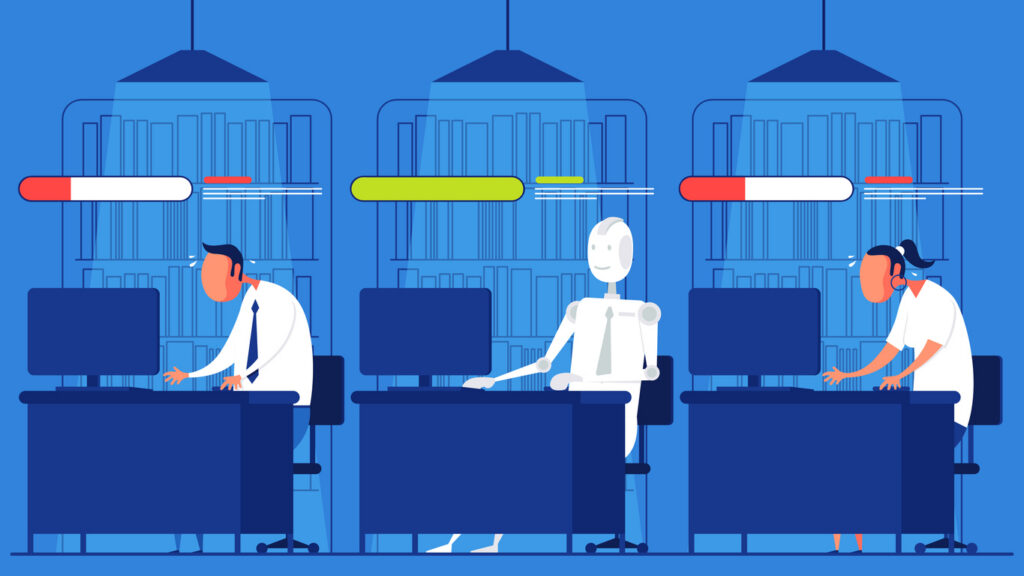
An AI sales agent doesn’t do this. It follows the process you configure — exactly, every time, without exception. There’s no drift. There’s no “I’ve been doing this for ten years and I know better.” There’s no Monday morning slump.
If your process is right, the AI executes it right. Every single lead, every single interaction, every single time.
It qualifies better at every step.
Bad qualification is one of the most expensive problems in sales. Reps spend time on prospects who will never buy. They don’t ask the hard questions because they don’t want to kill the deal. They optimistically advance deals that should be disqualified.
An AI sales agent doesn’t have ego in the game. It asks the qualifying questions. It listens to the answers. It scores accordingly. It doesn’t avoid uncomfortable conversations because it’s not trying to hit a personal commission target.
Better qualification means your human reps spend their time on real opportunities. Not wishful thinking disguised as a pipeline.
It captures perfect data. Always.
Ask any sales manager how confident they are in the data in their CRM. Most will laugh. Because data capture depends on a rep doing it manually, after the fact, when they’d rather be doing something else.
An AI sales agent captures everything — every interaction, every response, every piece of qualifying information — accurately and automatically. No missing fields. No “I’ll update that later.” No guessing what happened in a conversation six weeks ago.
That data compounds in value over time. It makes your AI smarter. It makes your human reps more effective. It makes your pipeline reporting actually reliable.
It sells on value, not margin.
Here’s one of the most expensive habits in sales: when a rep is under pressure — end of month, quota anxiety, personal stress — they discount. They drop the price because it’s the path of least resistance to getting a deal across the line.
An AI sales agent doesn’t have that pressure. It doesn’t have a bad month. It doesn’t have a mortgage payment due. It doesn’t have a sales manager breathing down its neck.
It follows your value proposition. It articulates the ROI. It handles price objections the way you trained it to — not the way a tired rep defaults to at 4:30 on a Friday afternoon.
The margin protection alone often pays for the entire implementation.
It works 24/7. Without sick days, bad months, or a competing job offer.
Your prospects don’t operate on business hours. They send enquiries at 9pm. They do research on weekends. They respond to follow-ups when they have a moment — which is often not Monday to Friday, 9 to 5.
An AI sales agent is always available. It responds immediately. It doesn’t take annual leave. It doesn’t get headhunted. It doesn’t hand in its notice two weeks before your biggest tender of the year.
For businesses dealing with inbound enquiries, this alone is a step-change in conversion. Speed to lead is one of the strongest predictors of close rate. An AI sales agent is always first.
The Numbers That Should Make You Uncomfortable
I’m going to put some numbers in front of you. Read them carefully.
Sales reps spend only 25–28% of their time actually selling. The rest is admin, internal meetings, data entry, and everything else that isn’t revenue generation. This is not an opinion, it’s a measured reality (Salesforce and Bain & Company research, 2025).
Think about what you’re paying your sales team. Now think about the fact that roughly three-quarters of that cost is producing no direct sales activity.
Bain & Company’s 2025 research also found that AI effectively doubles active selling time — and that early AI deployments have boosted win rates by more than 30%.
Gartner research shows sellers using AI are 3.7 times more likely to meet quota than those who don’t.
LinkedIn’s 2025 State of Sales report found that 69% of sellers using AI shortened their sales cycles by an average of one week — and that 56% of sales professionals use AI daily, with those users twice as likely to exceed targets.
McKinsey’s 2025 analysis found that AI sales tools can increase leads by 50%, reduce costs by up to 60%, and cut call times by 70%.
And research cited by Apollo.io and Sopro found that 83% of sales teams using AI reported revenue growth, compared to 66% of those without it.
Now here’s what should make you uncomfortable: your competitors are reading the same data. The businesses that are moving on this now will have 12 to 18 months of real-world learning advantage over those who wait. That’s not a recoverable gap in a fast-moving market.
The window to act is not permanently open.
90 Days to Replacing 50% of Your Sales Work
When I tell business owners that they can replace 50% of their sales work with an AI sales agent in 90 days, I get one of two reactions. Either they lean in, or they assume I’m selling something that sounds too good.
So let me be specific about what “50% of your sales work” actually means.
It’s not the complex relationship management. It’s not the negotiation on a six-figure deal. It’s not the meeting where you need to read the room and adjust in real time. Those things still need humans.
The 50% is everything else.
The initial outreach and follow-up sequences. The qualification calls. The CRM data entry. The post-meeting summaries. The nurture emails. The scheduling. The proposal follow-ups. The pipeline reporting. The re-engagement of cold leads. The triage of inbound enquiries.
Every one of those activities can be handled by a well-configured AI sales agent — better, faster, and more consistently than a human doing it as their fifth priority on a busy Tuesday.
Your human reps, freed from that administrative load, focus on what humans are genuinely good at: complex relationships, reading emotion, negotiating the deals that require trust built over months, closing business that requires real-world presence and judgment.
As for the 90 days — this is what it actually looks like at a high level:
- Weeks 1–3: Building your knowledge base. This is the foundation — your products, pricing, objections, ideal customer profile, and sales process all documented and structured. It’s the step most businesses skip, and it’s the reason their AI doesn’t work.
- Weeks 4–6: Process mapping and configuration. Your AI agent is configured to your specific sales process, your qualification criteria, your value proposition.
- Weeks 7–10: Build and integration. The agent is built and integrated with your existing CRM and communication systems.
- Weeks 11–12: Testing, refinement, and deployment. You run it live, identify edge cases, refine the responses, and get it performing to standard.
At the end of 90 days, you have a functioning AI sales agent doing 50% of your sales team’s work — better than your reps were doing it, 24 hours a day, seven days a week.
That’s not a pilot programme. That’s a structural shift in how your business goes to market.
The Perfect Sales Rep (And Why That Changes Everything)
In 20+ years and over 1,000 sales reps, I have never hired the perfect salesperson. Not once.
I’ve hired great ones. I’ve hired reps who were exceptional at building relationships but terrible at qualification. I’ve hired reps who could close anything but couldn’t be trusted to follow a process. I’ve hired reps who did everything right for six months and then left for a competitor.
The perfect sales rep — the one who follows the process every time, qualifies rigorously, captures perfect data, sells on value, never has a bad day, and never leaves — doesn’t exist as a human being.
It exists as an AI sales agent.
This matters more than most business owners realise. Because the problem with sales performance isn’t just the ceiling — it’s the floor. Your worst month of sales performance is usually your real problem, not your best month. A business where performance swings wildly depending on who’s in, who’s motivated, and who’s about to resign is a business without a real competitive advantage.
An AI sales agent raises your floor. Permanently.
Your consistency of execution becomes a structural advantage. Your best month of sales performance starts to look like every month. Your worst month looks like your old best month.
That consistency is the competitive advantage. Not the technology itself — what the technology produces in terms of predictable, scalable, margin-protected sales performance.
This Is Not the Future. It’s Happening Now.
I want to be direct with you about something, because I think too many conversations about AI still use future tense when they should be using present tense.
The technology exists today. AI sales agents are live in businesses right now. They are qualifying leads, following up prospects, nurturing pipelines, and protecting margins — right now, in businesses that look a lot like yours.
Research by Datagrid found that 87% of businesses believe AI gives them a competitive edge. But the majority haven’t built it yet. That gap between belief and action is your opportunity — and it’s closing.
AI also improves with use. Every interaction makes it smarter, more calibrated to your market, better at handling the specific objections your prospects raise. The businesses that start now accumulate that learning advantage. The businesses that wait will be building from scratch against competitors who have 12 to 18 months of real data behind them.
This is not a “wait and see” situation. I’ve watched businesses wait and see on CRM adoption, on digital marketing, on e-commerce. In every case, the businesses that moved early built advantages that the laggards never recovered.
AI in sales is that moment. And unlike some of those previous shifts, this one moves faster.
The question is not whether AI sales agents will become standard in sales. They will. The question is whether you’ll be the business that built it first in your market — or the business playing catch-up.
Ready to Build Your AI Sales Agent?
At Due North, we build AI sales agents for businesses — specifically designed for the $1M to $100M businesses that need a real competitive advantage, not an enterprise software licence they’ll never fully use.
Our implementation gets you to a live, functioning AI sales agent in 90 days.
If you want to understand what an AI sales agent could do for your specific business, let’s have a direct conversation about it.
No pitch deck. No demo of generic software. A real conversation about your sales operation and what’s actually possible in your market.
The businesses acting on this now will be the ones your competitors are trying to reverse-engineer in 18 months.
Don’t be the one doing the reverse-engineering.